The 5-minute window: why response time decides almost every inbound real estate lead
Most residential real estate teams run a slow first-touch on inbound leads — 30 minutes, 2 hours, sometimes overnight — and treat the resulting low conversion as a quality-of-lead problem. It is not. Decades of consistent industry data show the conversion drop is almost entirely about response time. The 5-minute rule is real, the math is brutal, and most brokerages are spending tens of thousands of dollars a month on leads that never get a real chance.
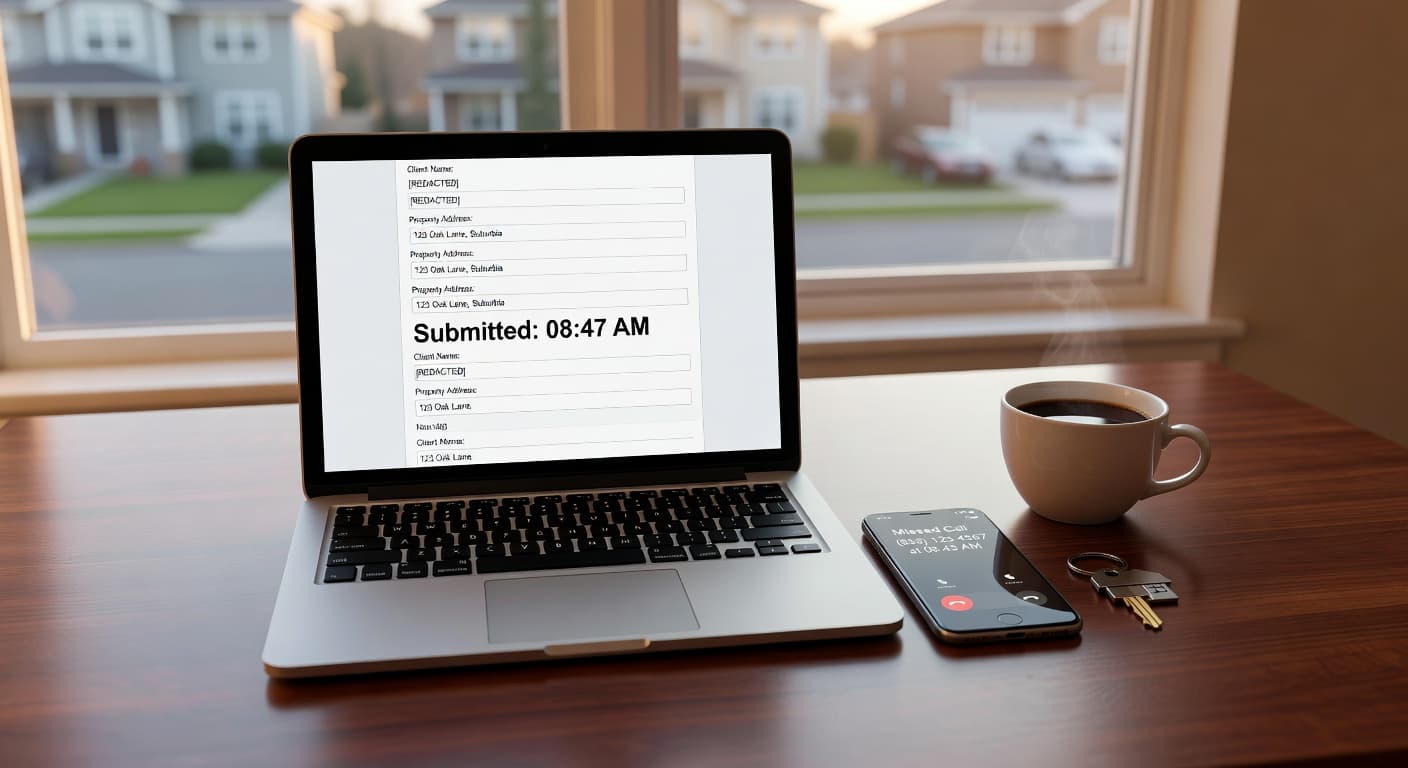
The average brokerage responds to inbound web leads in 4+ hours. Industry research consistently shows that conversion drops by an order of magnitude as response time moves past 5 minutes. Every hour of delay is most of the ad spend going to waste.
An auto-acknowledgment + qualifying SMS within 60 seconds of form submission, followed by a real-agent callback within 5 minutes during business hours. The acknowledgment alone — even before a human gets involved — converts at 3-4× a silent wait.
Real estate is a response-time business — full stop
When a buyer fills out a contact form on a listing page, they are not browsing for fun. They are usually within 30 days of buying, often within 90 days of moving, and they have just done the most decisive thing a website visitor can do: they typed their phone number into a stranger's form.
What they do next is predictable. They fill out the same form on two or three other sites — Zillow, Redfin, a Realtor.com listing, another brokerage's site. Whoever responds first usually wins the conversation. The buyer is not measuring response quality at this stage; they are measuring response existence. Did anyone actually talk to me?
Most brokerages treat that decision moment as if it were a leisurely buying journey. The lead lands in a CRM. The on-call agent gets an email notification (or worse, a daily digest). Hours go by. The buyer has already booked a showing with whoever responded in five minutes.
The data, in case anyone is still arguing
Lead response-time research has been replicated dozens of times across multiple industries, and real estate specifically shows the steepest curve. The findings are remarkably consistent:
- Response within 5 minutes: conversion rate roughly 7× higher than response within 30 minutes
- Response within 30 minutes vs. 1 hour: conversion rate roughly 2× higher
- Response within 1 hour vs. 4 hours: conversion rate roughly 3× higher
- Response after 24 hours: lead is effectively dead — typical conversion is below 1%
These numbers come from Harvard Business Review's research on lead-response, MIT's earlier work, and broker-specific studies from Zillow, BoomTown, and CINC over the past decade. Different studies cite slightly different exact percentages, but the shape of the curve is identical every time: conversion drops exponentially as response time grows, and most of the drop happens in the first 30 minutes.
Worth saying plainly: most brokerages I look at are responding to inbound leads in 4+ hours. They are spending real ad-spend dollars to acquire those leads and then losing 80–90% of them to response delay.
Why brokerages stay slow
Three reasons that show up consistently:
- The lead routes to whichever agent is on the rotation. That agent might be in a showing, at lunch, or — most commonly — driving between properties. They will respond when they can. "When they can" is usually too late.
- The on-call agent assumes the lead is low quality. Buyer's psychology of filling out web forms has changed; serious buyers do this all the time now. The old heuristic of "web form = tire kicker, referral = real client" no longer holds in 2026.
- CRMs do not enforce response SLAs. The lead lands in a list. There is no buzzer, no priority queue, no visible accountability. It is everyone's job and therefore nobody's.
None of these are character flaws. They are systemic. Fixing them requires changing the workflow, not pressing harder on the same agents.
What "respond" actually means
There is a subtle but important distinction between acknowledge and engage. An acknowledgment is automated: "Hi [Name], thanks for reaching out about [property] — an agent will be in touch within the next few minutes." An engagement is a real human conversation about what the buyer is actually looking for.
Most brokerages treat "response" as engagement only and skip the acknowledgment. That is exactly backwards. The acknowledgment is what wins the race against the other brokerages on the buyer's form-submission list, and it can happen in 60 seconds without a human involved. The engagement happens in the next 5–30 minutes when a real agent picks up the thread.
A working flow looks like this:
- 0 seconds: buyer submits form
- 60 seconds: automated SMS goes out — "Hi [Name], saw your interest in [property]. I'll have an agent reach out within 5 minutes. Anything specific you wanted to ask about the place?"
- 2–5 minutes: if the buyer replies to the SMS with any context, that goes to the on-call agent
- 5 minutes: the on-call agent calls the buyer with the context already in hand
- 30 minutes: if no human contact yet, the system pages the second-tier agent
The 60-second acknowledgment by itself — even with no human follow-up for 30 minutes — converts at 3–4× a silent wait, because the buyer perceives the brokerage as having responded.
The math for a brokerage
A typical mid-sized real estate brokerage runs roughly the following numbers on inbound web leads:
- 150 web leads per month
- Average response time: 4+ hours
- Current conversion rate to actual buyer relationship: ~2%
- Average commission per buyer-side transaction: $8,000–$15,000
- Result: 3 transactions/month from web leads, $24K–$45K of monthly commission revenue
Same brokerage with a 5-minute SLA and an auto-acknowledgment within 60 seconds:
- Same 150 web leads
- Response time: 5 minutes for 80% of leads, longer for 20%
- Conversion rate: ~6–8%
- Result: 9–12 transactions/month, $72K–$180K of monthly commission revenue
These are rough industry-typical numbers. The exact lift depends on local market, ad spend mix, and existing conversion baseline. The shape is consistent: investing 60 seconds of automated acknowledgment and a 5-minute SLA on the human side roughly 3–4×s the conversion of web leads.
The cheap fix vs the real fix
Cheap fix: a single agent or assistant on a 9–6 schedule answering the leads board the moment they hit. This works for a small team with low lead volume. Breaks at the edges (evenings, weekends, lunch hours, vacation, sick days).
Real fix: an AI-assisted intake that auto-acknowledges within 60 seconds, qualifies the buyer with 2–3 questions (timeframe, budget range, financing status), and routes the qualified leads to the on-call agent with the context attached. Unqualified leads (just-curious, no real intent, wrong city) get a polite drop without consuming agent time.
Either approach beats the current state of most brokerages. The AI approach scales without re-hiring as lead volume grows.
One last thing about Saturdays
Worth noting: web leads do not distribute evenly across the week. Saturday morning is consistently the highest-volume slot for inbound real estate leads, followed by Sunday evening and Monday morning. Most brokerages staff their lead-handling lightest exactly when the leads come in heaviest.
If you are going to start improving response time, start with Saturday morning specifically. Two hours of focused, low-friction acknowledgment between 9am and 11am Saturday catches more inbound demand than any other staffing change you could make.