Auditing your own HVAC inbox in 15 minutes: 4 signals you're losing jobs
Most HVAC owners have never actually audited their own inbox. They run on intuition: "we get most of the leads we should be getting." Usually they don't. Here are four signals that show up in any contractor's inbox + phone log and the rough dollar value attached to each.
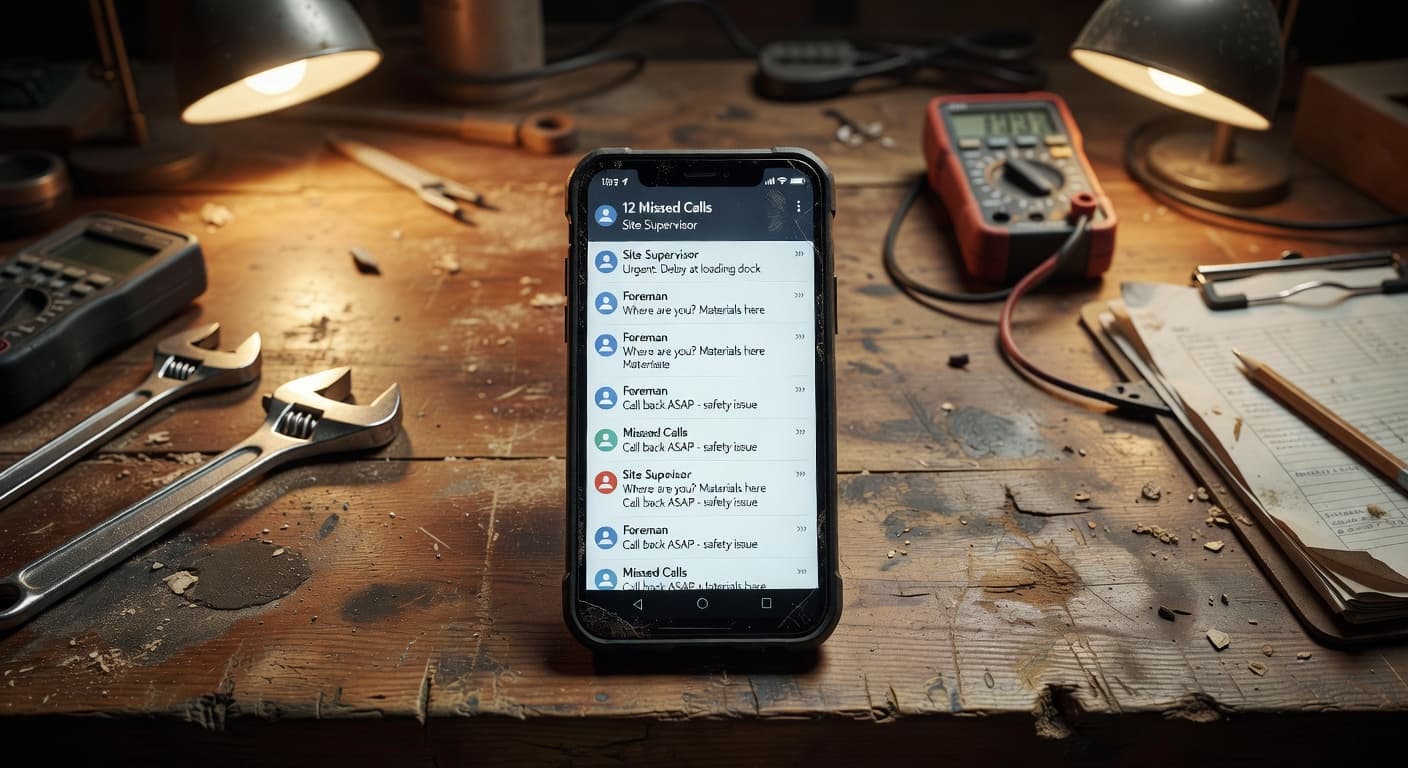
Owners who haven't audited their inbox in years assume they're capturing most of their incoming demand. The dollar value of what's leaking is usually 2–5x what they'd guess.
A 15-minute self-audit that surfaces the four most common gaps: voicemails with no callback logged, stale web-form submissions, quotes that died without follow-up, and customer complaints about response time hiding in your Google reviews. With dollar values attached.
Why this audit is worth 15 minutes of your week
Most HVAC owners I talk to have never sat down and actually audited their own inbox. They run on intuition: "we get most of the leads we should be getting." When I ask them to walk me through a specific week's call log + email + Google Business Profile inbox, the answers usually shift inside five minutes.
Not because the owner is wrong about the business overall — most of them have good gut feel for revenue and pipeline. But intuition is shaped by what you see in your active customers, not by what you're missing. Missed-lead patterns are silent by definition. They don't show up in your books, they don't trigger any alerts, and the customers you didn't serve never tell you.
The audit below takes 15 to 20 minutes. The four signals it surfaces tell you which of your inbound channels is leaking the most money. Once you know that, you can fix the largest gap first instead of doing five things that might individually move the needle.
Before you start: what to have open
You need three things accessible:
- Your phone log for the last 7 days. From your business phone — landline, VoIP, RingCentral, whatever you use. You want the timestamps, not just the numbers.
- Your web-form submissions for the last 30 days. Whatever shows up when someone fills out the "Get a quote" form on your site. If it lands in an
info@email inbox, open that. If it goes to a CRM (ServiceTitan, Jobber, Housecall Pro), open the Leads tab. - Your Google Business Profile, with reviews sorted by most recent. Twelve months of reviews is enough.
Roughly 15 minutes. Read down each signal below and check the corresponding source. Each signal has a rough dollar value attached so you can compare them.
Signal 1: Voicemails without a callback logged
Open your phone log. Find every inbound call from the last 7 days that went to voicemail. Now check whether each one shows a follow-up outbound call from your team within 4 hours.
What you're looking for: voicemails that never got a callback at all, or got one the next morning.
What it means: every one of those is a customer who probably called the next contractor on Google after they hung up. Most modern homeowners don't leave voicemails — they just try the next number. So the count of unreturned voicemails is the LOW estimate of missed calls. Add roughly 2x for the calls that came in, rolled to voicemail, and the caller hung up without leaving anything.
Rough dollar value: for a typical residential HVAC contractor, every missed inbound call is worth $300–$500 in expected revenue (most calls during business hours convert at 25–40% if answered live, at an average residential ticket of $1,000–$2,000). A contractor with 5 unreturned voicemails per week is missing $7,800–$13,000/month at the low estimate, $15K–$25K/month at the more realistic estimate.
Where this happens: almost always after-hours, weekends, and during lunch — when the dispatcher is busy or off. The fix is straightforward: an answering service for the cheap version, or an AI receptionist that actually qualifies the call and books appointments for the better version.
Signal 2: Web-form submissions older than 24 hours, unread or unactioned
Open your info@ inbox (or wherever your web forms land). Sort by date. Scroll back 30 days. Count every web-form submission with no outbound reply timestamp.
What it means: every one of those is a homeowner who took the active step of filling out your form — which is high-intent behavior — and got zero response from your business. Almost all of them filled out forms on two or three competitor sites that same day. The first contractor to respond won the conversation.
Rough dollar value: web-form leads convert at 7–10x higher when responded to in under 5 minutes versus over an hour. For a contractor with any digital ad spend, slow response is silently halving the effectiveness of every ad dollar. If you're spending $2K/month on Google Ads driving form submissions and responding in 4+ hours, you're effectively spending $1K of that wasted.
Where this happens: any inbox that isn't somebody's primary inbox. If your web forms route to info@ or quotes@ or a CRM tab, they get the lowest-priority attention. They should be triggering an SMS/email to the dispatcher within 60 seconds, and (better) auto-acknowledging the customer with a templated reply in the same window.
Signal 3: Estimates sent without a follow-up trail
Open your most recent 15–20 estimates. For each, look at what happened after the estimate was sent.
Three states you'll find:
- Closed (booked the job): good. Move on.
- Lost to a competitor (customer said so): also fine — at least you know.
- Silent (no response, no follow-up from you): this is the problem state.
What you're counting: how many of your estimates went silent without any follow-up from your team. Industry-wide, most contractors leave 60–80% of their estimates in this silent state. They blame the silence on "the customer went with somebody cheaper" — but they don't actually know that. They never asked.
Rough dollar value: the contractor who runs even a single follow-up message at 3 days closes roughly 30–50% more of their pipeline than the contractor who doesn't. For a contractor sending 25 estimates a month at $4,000 average residential ticket, that's $30K–$50K per month in revenue you're leaving on the table.
Where this happens: the gap between "estimate sent" and "job booked" in nearly every CRM. There's almost never an automatic system that triggers follow-up. Manual reminders work if you have under 20 estimates a month; automated workflows are necessary above that volume.
(For the actual cadence I recommend, see the companion post on the three-touch follow-up.)
Signal 4: Response-time complaints in your Google reviews
Open your Google Business Profile. Sort reviews by most recent. Look at the 1-star and 2-star reviews from the last 12 months.
What you're scanning for: complaints that mention any of these phrases:
- "Took forever to call back"
- "Never got back to me"
- "Had to call multiple times"
- "No one answered"
- "Voicemail full"
- "Form on the website didn't work / no one responded"
Even one such review in the last 12 months is meaningful. Three or more is a strong signal that your inbound capture has a chronic gap that customers are publicly documenting.
Rough dollar value: this one is harder to quantify but probably the biggest of the four. Every 1-star or 2-star review on your Google profile costs you future leads forever. Prospective customers read the bad reviews before deciding to call you. A contractor with 4.6 stars + 30 reviews gets meaningfully fewer leads than one with 4.8 stars + 30 reviews, all else equal — and the gap compounds as both contractors accumulate more reviews over time.
The hidden value of this signal: if customers are documenting your response-time problem in public, your *competitors* are seeing it too. They use it. "We always pick up the phone" is a competitive position you can't take if there are reviews that say you don't.
Adding it up
Add the four rough dollar values you found, even at the low end. For a typical residential HVAC contractor, the total usually lands in the $40K–$80K per month range. Many of the contractors I look at are above that.
You don't have to believe the numbers. The point of the audit is to surface the *signals* — the specific voicemails, the specific forms, the specific estimates, the specific complaints — so you can put faces and dollar amounts on what was previously invisible.
Quick fixes you can deploy this week
Each signal has a corresponding fix that doesn't require any new technology to start with:
- Signal 1 (voicemails): every voicemail in your inbox right now should get a callback by the end of today, regardless of how old it is. Yes, some of them are too old to recover. Some aren't. Then put a hard rule in place: every voicemail gets a callback within 2 hours during business hours.
- Signal 2 (web forms): add an auto-reply to whichever inbox receives them. Even a templated "Thanks for reaching out, [name from dispatcher] will be in touch within an hour" is a 10x improvement over silence. Then enforce the 1-hour SLA internally.
- Signal 3 (estimate follow-up): pick your 5 oldest open estimates and send a 1-line follow-up text to each one today. Some will close. That's data on what this workflow is worth at zero new investment.
- Signal 4 (response-time reviews): publicly respond to every existing 1-star and 2-star review that mentions response time. Briefly, professionally, with a real apology and an offer to make it right. Future customers reading your reviews see your response, not just the complaint.
None of these fixes are the long-term answer. The long-term answer is automation that handles all four signals systematically without requiring the owner to remember. But the manual fixes above will move the needle this week — and they tell you whether the automated version is worth investing in.
Closing
If you ran the audit and want to talk through what you found, book a free 15-minute call. Bring your numbers — I'll tell you which of the four signals to fix first based on what your inbox actually shows, and what the workflow to fix it would look like for your business specifically.
If you didn't run the audit and got here from skimming, scroll back up. The whole post is 15 minutes of your time invested in figuring out where the largest gap in your business currently is. Worth it.