Why your auto repair shop's review count compounds 10x slower than your competitor's
Two shops on the same street do roughly the same quality of work. After three years one has 380 Google reviews and the other has 42. The work isn't different — the asking is. Here's the review-request cadence that actually compounds, and the local-SEO math behind why it matters more than most shop owners realize.
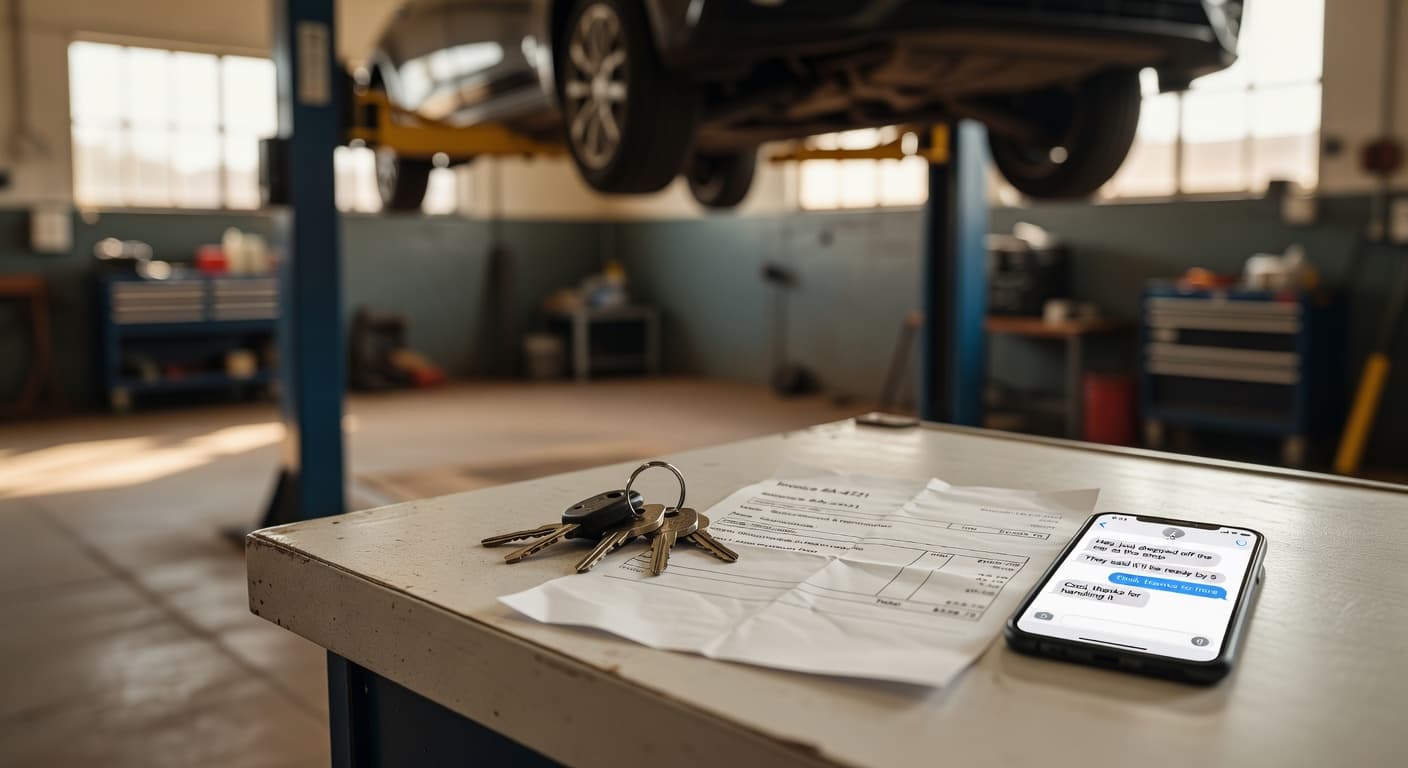
Most auto repair shops never ask customers to leave a review, then watch their competitor pull ahead on Google Maps year after year. The work is the same; the review pipeline isn't.
An automated review-request flow timed to the day after pickup, sent by SMS (not email), routed through a smart-link that catches unhappy customers before they go public. ~$0 to set up, ~30% of customers leave a review when asked this way.
Two shops, same street, ten-year divergence
Picture two independent auto repair shops on the same commercial strip. Same kind of work — brakes, oil changes, suspension, the occasional engine job. Same number of bays. Owners both reasonably skilled, both reasonably honest. Both opened around the same time.
Ten years later, one has 380 Google reviews at a 4.8-star average. The other has 42 reviews at a 4.6 average. The first shop is booking three weeks out. The second is leaning on referrals and word of mouth and wondering why they keep getting price-shopped against bigger chains.
It is not the work. It is not the prices. It is not even the marketing budget. It is that one shop, for ten years, asked every customer for a review the day after they picked up the car — and the other one never built the habit.
This is the compounding gap in local-services businesses, and once you understand the math, it is hard to unsee.
The local-SEO math, briefly
Google Maps rankings are driven by three things in rough order of weight: relevance to the search, distance from the searcher, and prominence. Prominence is mostly about reviews — count, recency, average rating, and whether the business actively responds.
Two shops in the same neighborhood competing for "auto repair near me" are effectively tied on relevance and distance. Reviews are the tiebreaker. The shop with 380 reviews ranks above the shop with 42 for almost every relevant search, even if their average rating is fractionally lower.
And here is where it compounds. Higher ranking → more inbound clicks → more bookings → more potential reviewers. The shop already ahead generates more review opportunities per month than the one behind. The gap widens every quarter.
Most shop owners learn this the hard way years in, when they finally check their Google Business Profile against a competitor's and realize they are not catching up — they are falling further behind every month, doing the same quality of work.
Why most shops do not ask
Three reasons consistently show up when I talk to shop owners about why they do not run a review-request flow:
- It feels pushy. "My work should speak for itself." Honest sentiment, totally unhelpful in practice. The work does not speak for itself — Google does.
- It is forgettable. The car is picked up, the owner gets paid, the next car comes in. By 5pm the ask has slipped. Without a system that fires automatically, it stays forgotten 95% of the time.
- They tried once and got a bad review. One customer was unhappy about something minor, got asked to review, and aired it publicly. The shop owner concludes asking is risky, never asks again. Wrong lesson — the right lesson is that the ask should route unhappy customers to a private channel first, not to Google Maps.
The right ask: timing, channel, template
The review-request flow that consistently produces a ~30% response rate has three specific characteristics.
Timing: 18–36 hours after pickup
Same-day is too soon — the customer is still driving home. Three days later is too late — the experience is fading. The sweet spot is roughly the day after pickup, in the early afternoon. The customer has driven the car, has noticed if anything is off, and the experience is still fresh.
Channel: SMS, not email
Email open rates for service businesses run around 20–25%. SMS open rates are above 95%. For a one-shot ask like this, SMS wins by a factor of four.
There is a compliance edge to be aware of — TCPA in the US requires that you have explicit consent to text the customer for promotional purposes. Most shops collect a phone number on the intake form; adding a single checkbox that says "I agree to occasional service follow-up texts" handles this cleanly.
Template: short, optional, single-tap
The text that works does three things in under 200 characters: thanks the customer, gives them the link, and explicitly removes pressure.
Hey [Name] — thanks for trusting us with the [vehicle]. If you have 30 seconds, a quick Google review would mean a lot — [link]. No pressure at all if not.
Two things to notice. First, the phrase "no pressure at all if not" actually increases response rates because it removes the social anxiety of the implied obligation. Second, the link should go to a smart router (see next section), not directly to your Google profile.
The unhappy-customer routing trick
Send everyone directly to your Google profile and you will eventually get a 1-star review from someone who could have been turned around privately. Smart shops route the request through an intermediate page:
- Customer taps the SMS link
- Sees a one-question form: "How was your service today?" with 1–5 stars
- 4–5 stars → routed to your Google Business Profile to leave the public review
- 1–3 stars → routed to a private form that emails the shop owner directly with the complaint
This is not deception. The unhappy customer can still leave a public review if they want — they were not stopped, they were just given a faster path to be heard privately first. About 70% of customers who would have left a 2-star public review will instead send a private complaint, which the owner can usually resolve (refund, fix, follow-up service). The other 30% leave the public review anyway, which is also fine.
The net effect on the public profile: more 5-star reviews, meaningfully fewer 1- and 2-star ones, and a fairer overall rating for the actual quality of the work.
Tools that do this out of the box: Birdeye, Podium, NiceJob, ReviewBuzz. Or you can build it as one webhook + one routing page in an afternoon if you have a developer.
The math, with rough numbers
A shop doing 25 jobs a week with a review-request flow asking on every job:
- 25 jobs/week × ~30% ask-to-review conversion = ~7–8 new reviews/week
- Roughly 350–400 new reviews per year
- After three years: 1,000+ reviews, 4.8 average, top-3 ranking for every relevant search in your zip code
Same shop without a review flow:
- 2–3 unprompted reviews per month at best, often closer to 1
- ~30 reviews/year
- After three years: 90 reviews, average is whatever it is, ranking permanently below any competitor with an active review pipeline
The work was identical. The gap is one workflow.
A 30-minute fix
If you want to start asking tomorrow without any new tools:
- Type up the SMS template above as a saved reply on your phone
- For the next week, every time a customer pays and picks up, jot their phone number into a sheet with the date
- At 10am the next morning, send each one the text manually
- Track responses in the same sheet
That manual version, run for one week, gives you the data to decide whether automating it is worth the $50–$200/month most review tools charge. For nearly every shop I have looked at, it is — the ROI shows up in week three when the first wave of new reviews starts changing your search ranking.